
Most people know that flu season picks up during the winter. But many overlook one of the main reasons why:
The air inside our homes gets too dry.
When indoor humidity drops, your body’s natural defenses weaken. Viruses survive longer in the air. And your risk of infection goes up.
However, supporting your respiratory defenses doesn’t require expensive treatments. With just a humidifier and a few essential oils, you can strengthen your immune system where it matters most—right at the airway lining.
Why Dry Air Makes You More Vulnerable to the Flu
Your respiratory tract—from your nose to your lungs—is lined with mucosal surfaces. These act as a first line of defense, trapping viruses and bacteria before they can spread.
But dry air (common in heated homes during winter) causes:
- Thinner, less effective mucus
- Dryness and cracking of airway linings
- Reduced mucociliary clearance (your lungs’ natural cleanup system)
- Longer airborne survival time for flu viruses
Research shows that flu viruses spread more easily and stay active longer in low-humidity environments. One study found that indoor humidity levels above 40% significantly reduced the infectiousness of airborne influenza particles (Noti et al., 2013).
The Humidity Sweet Spot: 40–60%
Keeping your home’s humidity in the 40–60% range offers a simple but powerful layer of protection.
Benefits include:
- Better hydration of the nasal passages and lungs
- Improved clearance of airborne particles and pathogens
- Lower survival rates for flu viruses on surfaces and in the air
- Reduced static, better sleep, and less throat irritation
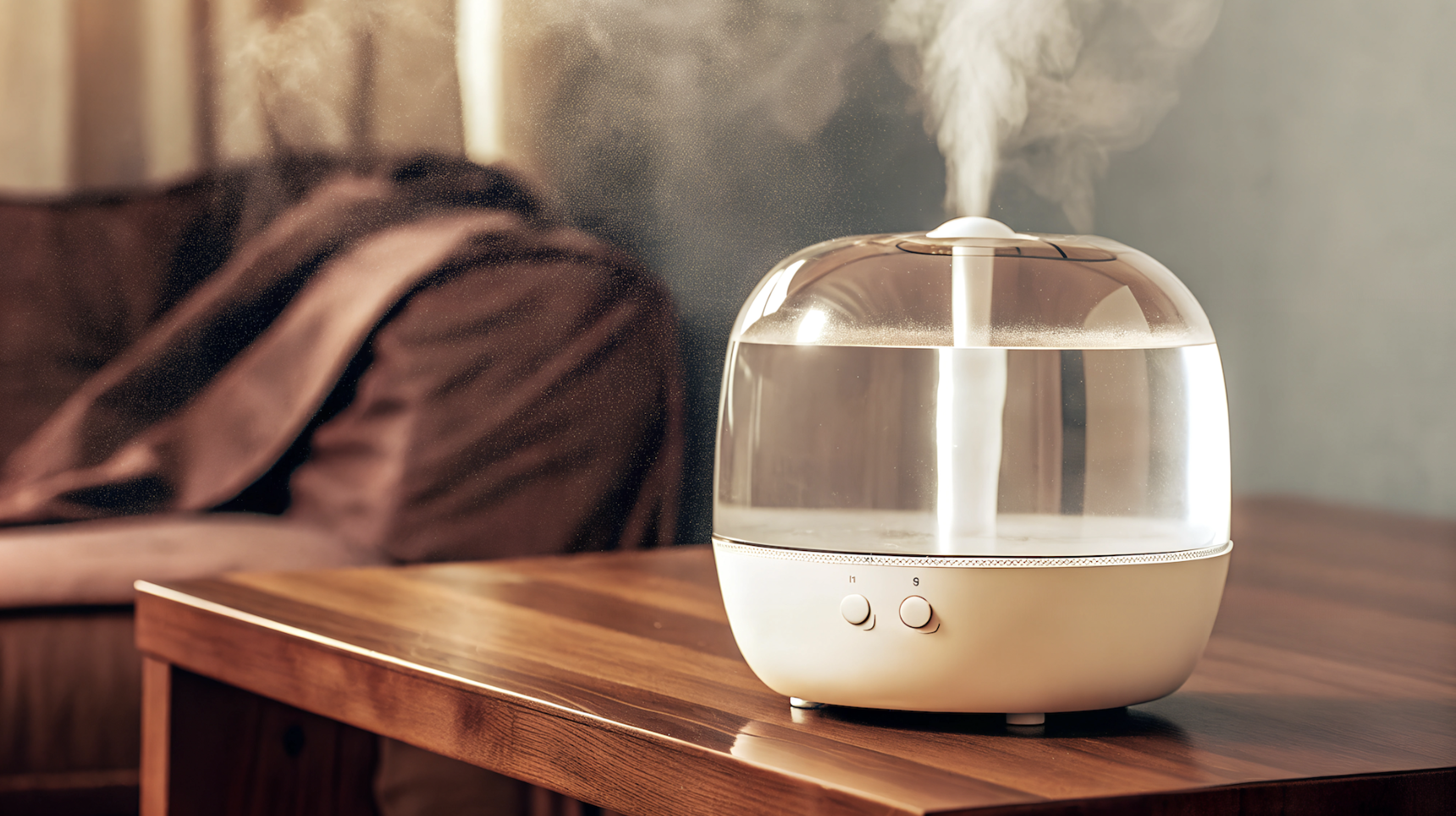
You can measure humidity with a basic hygrometer and adjust your home’s humidity with a cool mist humidifier.
Take It a Step Further: Diffuse Essential Oils with Antiviral Properties
Many essential oils have demonstrated antiviral and immune-supportive properties in laboratory studies. When used in safe, diluted concentrations, diffusing essential oils into a properly humidified space can enhance air quality and support the immune system.
According to a 2022 review published in Frontiers in Pharmacology, several essential oils exhibit antiviral activity in vitro against common respiratory viruses, including influenza A (Mieres-Castro et al., 2022).
Our top essential oils for flu season:
- Marjoram Oil
- Demonstrated >50% inhibition of influenza virus activity in cell culture models.
- Rich in terpinen-4-ol and linalool.
- PMCID: 30584499
- Clary Sage Oil
- also showed >50% reduction in viral cytopathic effects
- contains antiviral compounds like linalool and sclareol.
- PMCID: 30584499
- Anise Oil
- high in anethole, an antiviral compound with broad-spectrum activity.
- PMCID: 30584499
- Eucalyptus
- Opens the airways, breaks up mucus, and may reduce viral adhesion
- Shown to inhibit influenza A virus replication in vitro
- PMCID: PMC8706319
- Lavender
- Calms inflammation, supports mucosal healing, and promotes sleep
- Has documented antiviral activity against influenza strains
- PMCID: PMC6007527
- Tea Tree (Melaleuca)
- Broad-spectrum antimicrobial, shown effective against enveloped viruses
- Useful for disinfecting air in indoor spaces
- ScienceDirect Study
- Thyme & Clove
- Strong antiviral activity due to thymol and eugenol
- Use cautiously and always dilute well
- PMCID: PMC6296812
- Lemon or Peppermint(optional additions)
- Antioxidant and air-cleansing properties
- Can help support respiratory comfort and mood
Disclaimer: These studies demonstrate antiviral effects in vitro (lab settings), not in human clinical trials. While essential oils may reduce airborne viral load or ease respiratory symptoms, and are best used as complementary tools rather than standalone treatments.
How to Use Them Safely
- Use a diffuser in a well-ventilated area
- Start with 2–4 total drops of essential oil per session
- Diffuse for 30–60 minutes, 1–2 times per day
- Avoid direct inhalation or undiluted oils
- Not all oils are safe for pets or children—use child-safe options like lavender and eucalyptus radiata when needed
Does This Really Help Prevent the Flu?
No single strategy is a guarantee—but small, evidence-supported actions add up.
By keeping your mucosal defenses strong with proper humidity and clean, moist air enriched with immune-supportive essential oils, you create an environment where viruses have a much harder time gaining a foothold.
This is not a replacement for medical care or prevention—but it is a low-cost, low-risk, and potentially powerful way to reinforce your first line of defense.
Want More Personalized Support?
At Resolve Medical, we help individuals and families build resilience against infections, improve recovery, and strengthen immune health year-round using a root-cause, systems-based approach.
If you’re looking for personalized immune support—or you feel like your system never fully recovers after illness—we’d love to help.
Schedule a Free Discovery Call
References
- Noti JD, et al. “High humidity leads to loss of infectious influenza virus from simulated coughs.” PLoS ONE, 2013. https://pubmed.ncbi.nlm.nih.gov/23460865/
- Mieres-Castro D, et al. “Antiviral Activities of Eucalyptus Essential Oils.” Frontiers in Pharmacology, 2022. https://www.ncbi.nlm.nih.gov/pmc/articles/PMC8706319/
- Vimalanathan S, Hudson JB. “Anti-influenza virus activity of essential oils and vapors.” American Journal of Essential Oils and Natural Products, 2013. https://www.sciencedirect.com/science/article/abs/pii/S0021850213000086
- Reichling J, et al. “Essential oils as antiviral agents—potential of essential oils to treat and prevent influenza.” Molecules, 2019. https://www.ncbi.nlm.nih.gov/pmc/articles/PMC6296812/
- Cavanagh HMA, Wilkinson JM. “Biological activities of lavender essential oil.” Phytotherapy Research, 2002. https://www.ncbi.nlm.nih.gov/pmc/articles/PMC6007527/
- Yang W, Marr LC. Dynamics of airborne influenza A viruses indoors and dependence on humidity. PLoS ONE. 2011;6(6):e21481. https://pubmed.ncbi.nlm.nih.gov/21731764/
- Wu S, Patel KB, Booth LJ, Metcalf JP, Lin HK, Wu W. Protective essential oil attenuates influenza virus infection: an in vitro study in MDCK cells. BMC Complement Altern Med. 2010 Nov 15;10:69. doi: 10.1186/1472-6882-10-69. PMID: 21078173; PMCID: PMC2994788. https://pubmed.ncbi.nlm.nih.gov/21078173/
Some links on this page may be affiliate links. As an Amazon Associate, Resolve Medical earns from qualifying purchases. This means we may receive a small commission if you choose to purchase through these links, at no additional cost to you. We only recommend products we believe are high-quality, evidence-informed, and aligned with our approach to personalized, root-cause medicine.